
Band D runs from £2,403.04 in unparished Warrington to £2,525.87 in Birchwood. Every band A to H by parish, why the rise was 7.48%, and the support scheme cut.
There is no single Warrington council tax bill. The borough has eighteen parishes and a large unparished middle, and each parish sets its own precept on top, so two Band D homes four miles apart can be £122.83 a year apart. Birchwood is the dearest at £2,525.87. Unparished Warrington and Cuerdley are the cheapest at £2,403.04.
Council tax went up 7.48% here in April 2026, above the 5% cap that applies to most of England, because the government gave Warrington special permission as part of a rescue package. The detail on that is further down; the figures first.
Everything below is taken from Warrington Borough Council’s published council tax bands and charges for 2026-27, the police and fire authorities’ own precept papers, and the council’s budget decision of 2 March 2026. Checked on 15 August 2026.
Every band, every parish, 2026/27
Find your parish, read across. If you are not in a parish, use the “Unparished” row: that covers most of the town centre and the older suburbs.
| Parish | A | B | C | D | E | F | G | H |
|---|---|---|---|---|---|---|---|---|
| Unparished | 1,602.02 | 1,869.03 | 2,136.03 | 2,403.04 | 2,937.04 | 3,471.05 | 4,005.06 | 4,806.07 |
| Cuerdley | 1,602.02 | 1,869.03 | 2,136.03 | 2,403.04 | 2,937.04 | 3,471.05 | 4,005.06 | 4,806.07 |
| Woolston | 1,609.58 | 1,877.85 | 2,146.11 | 2,414.38 | 2,950.90 | 3,487.53 | 4,023.96 | 4,828.75 |
| Walton | 1,619.16 | 1,889.02 | 2,158.89 | 2,428.75 | 2,968.47 | 3,508.19 | 4,047.91 | 4,857.49 |
| Stretton | 1,621.52 | 1,891.78 | 2,162.03 | 2,432.29 | 2,972.79 | 3,513.30 | 4,053.81 | 4,864.57 |
| Burtonwood & Westbrook | 1,624.44 | 1,895.18 | 2,165.92 | 2,436.66 | 2,978.14 | 3,519.61 | 4,061.09 | 4,873.31 |
| Hatton | 1,625.20 | 1,896.07 | 2,166.94 | 2,437.81 | 2,979.54 | 3,521.28 | 4,063.01 | 4,875.61 |
| Rixton with Glazebrook | 1,625.82 | 1,896.79 | 2,167.76 | 2,438.73 | 2,980.67 | 3,522.60 | 4,064.54 | 4,877.45 |
| Appleton | 1,626.36 | 1,897.42 | 2,168.49 | 2,439.55 | 2,981.67 | 3,523.79 | 4,065.91 | 4,879.09 |
| Culcheth & Glazebury | 1,628.48 | 1,899.89 | 2,171.30 | 2,442.72 | 2,985.54 | 3,528.37 | 4,071.19 | 4,885.43 |
| Poulton with Fearnhead | 1,633.56 | 1,905.82 | 2,178.09 | 2,450.35 | 2,994.87 | 3,539.39 | 4,083.91 | 4,900.69 |
| Great Sankey | 1,640.77 | 1,914.23 | 2,187.69 | 2,461.16 | 3,008.08 | 3,555.00 | 4,101.93 | 4,922.31 |
| Lymm | 1,649.00 | 1,923.83 | 2,198.66 | 2,473.50 | 3,023.16 | 3,572.83 | 4,122.49 | 4,946.99 |
| Grappenhall & Thelwall | 1,653.28 | 1,928.82 | 2,204.37 | 2,479.92 | 3,031.01 | 3,582.10 | 4,133.19 | 4,959.83 |
| Croft | 1,653.40 | 1,928.96 | 2,204.53 | 2,480.10 | 3,031.23 | 3,582.36 | 4,133.49 | 4,960.19 |
| Penketh | 1,655.18 | 1,931.05 | 2,206.91 | 2,482.78 | 3,034.50 | 3,586.23 | 4,137.96 | 4,965.55 |
| Stockton Heath | 1,660.32 | 1,937.04 | 2,213.76 | 2,490.48 | 3,043.92 | 3,597.35 | 4,150.79 | 4,980.95 |
| Winwick | 1,674.84 | 1,953.98 | 2,233.13 | 2,512.27 | 3,070.55 | 3,628.83 | 4,187.11 | 5,024.53 |
| Birchwood | 1,683.91 | 1,964.56 | 2,245.21 | 2,525.87 | 3,087.17 | 3,648.47 | 4,209.78 | 5,051.73 |
There is a ninth column on the council’s own schedule that most people never see: Band A (Disabled), which runs from £1,335.02 unparished to £1,403.26 in Birchwood. It applies when a Band A property qualifies for the disabled band reduction, which normally moves you down a band and has nowhere lower to go.
What your parish adds
Strip out the £2,403.04 that every Band D home in the borough pays to the council, the police and the fire service, and what is left is your parish precept. That is the whole of the difference between one Warrington address and another.
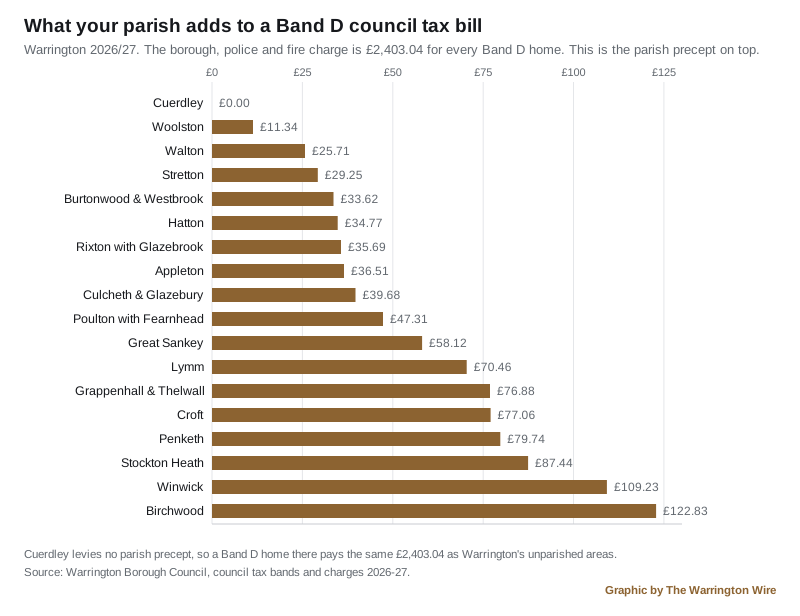
Birchwood’s £122.83 is more than ten times Woolston’s £11.34, and Cuerdley levies nothing at all, which is why a Cuerdley bill matches the unparished rate to the penny. Stockton Heath, Penketh, Croft and Grappenhall and Thelwall all sit between £77 and £88.
Where the money goes
The £2,403.04 unparished Band D figure is three separate charges added together:
| Charged by | Band D | Change this year |
|---|---|---|
| Warrington Borough Council | £2,007.51 | Up 7.48% |
| Cheshire Police and Crime Commissioner | £295.44 | Up £18.50, or 6.68% |
| Cheshire Fire Authority | £100.09 | Up £5.00, from £95.09 |
| Total, unparished | £2,403.04 |
The borough council keeps just over 83p in every pound.
Why the council’s rise was 7.48% and not 5%
Council tax increases are capped nationally at around 5% without a referendum. Warrington was allowed to go higher because it is in serious financial trouble and asked the government for help.
The council applied for exceptional financial support in December 2025, and the government’s answer included permission to raise council tax by an extra 2.5%. The council’s own figures put the four-year budget gap at £178.9 million to 2029/30, its in-year overspend for 2025/26 at £87.029 million, and its borrowing at around £1.4 billion. Full Council approved the budget on 2 March 2026, confirming £87.029 million of exceptional financial support for 2025/26, £92.047 million for 2026/27, and an initial £40 million savings programme.
The extra 2.5% raises £3.429 million a year. Cabinet member for finance Cllr Denis Matthews described the exercise as “the hardest budget we’ve ever had to set” and linked the pressure to the council’s “over-ambitious commercial approach”. Exceptional financial support is not a grant: it is repayable, over 20 years.
The police and fire elements
Cheshire’s Police and Crime Commissioner also went above the normal cap. The Home Office granted an extra £3.50 of flexibility, taking the Band D rise to £18.50, or 6.68%, and the Police and Crime Panel approved it on 6 February 2026. The precept leaflet sets out what it bought: 60 of Cheshire’s 87 PCSO posts were at risk, and the settlement saved 30 of them.
Cheshire Fire Authority signed off a £61.7 million budget on 11 February 2026 with a £5.00 Band D increase, from £95.09 to £100.09, according to the fire service’s own announcement.
How the bands work, and how to check yours
Bands are set by the Valuation Office Agency, not by the council, and they are based on what a property would have sold for on 1 April 1991. Not what it is worth now. A house built last year is still slotted into a 1991 price scale.
Every band is a fixed fraction of Band D, in ninths:
| Band | Proportion of Band D |
|---|---|
| A | 6/9 |
| B | 7/9 |
| C | 8/9 |
| D | 9/9 |
| E | 11/9 |
| F | 13/9 |
| G | 15/9 |
| H | 18/9 |
A Band H home pays exactly three times a Band A home, everywhere in England.
To find your own band, use the council’s band search by postcode or the VOA’s national listing.
Challenging a band is free, and it goes to the VOA, not to the council, via gov.uk. You cannot challenge the amount charged, only the band. Be wary of anyone offering to do it for a fee: the council links to the government’s own warning about council tax scams. If a property is derelict, being gutted or demolished, that is a deletion proposal rather than a band challenge, and there is a separate form.
Discounts, and the one that got cut this year
Single person discount is 25%. Warrington does not usually ask for proof when you apply, but it reviews claims regularly and asks you to re-confirm, and supplying false information carries civil penalties under the Local Government Finance Act and can be prosecuted under the Theft Act.
Other reductions worth checking on the council’s ways to reduce your bill page include students, apprentices and youth trainees, people who are severely mentally impaired, carers and people living elsewhere to give care, care leavers, annexes, members of the armed forces, people in prison or hospital, and the disabled band reduction.
Going the other way, Warrington charges premiums on property nobody lives in:
- Empty and substantially unfurnished for one year: a 100% premium, so the bill doubles in year two. Warrington brought this forward from two years to one in April 2024.
- Empty for five to ten years: a 200% premium.
- Empty for more than ten years: a 300% premium.
- Second homes have paid double since 1 April 2025.
There are national exceptions to the premiums, mostly time-limited to 12 months: property actively marketed for sale or let, property awaiting probate, annexes, armed forces accommodation and job-related dwellings. These are exceptions to the premium, not exemptions from council tax.
Council tax support is less generous from April 2026
This is the change that will hit hardest and has had the least publicity. From 1 April 2026, Warrington’s council tax support scheme:
- requires every working age claimant to pay at least 22% of their council tax bill, whatever their income
- cuts the capital limit from £16,000 to £6,000, so savings above £6,000 now disqualify you outright
The minimum award remains £2.00 a week, and second adult rebate has not existed here since 2022. Pension age claimants are covered by the national scheme rather than this one. The council’s worked example for a passported benefit shows a household charged £31.74 a week receiving £24.76. Full terms are on the council tax support page.
If you cannot pay, the council also operates Section 13A discretionary relief, which is a case-by-case power rather than an entitlement, and it is worth asking about before a summons is issued rather than after.
More Warrington local information: bin collection days, parking and car park charges, house prices and planning news.
Have your say